Figures indexed for academic preview only. Copyright © original authors.
Copyright / UnknownUnraveling the impact of urban expansion on vegetation carbon sequestration capacity: A case study of the Yangtze River Economic Belt
Jinyang Wang, Zhenfeng Shao, Peng Fu, Qingwei Zhuang, Jiahui Chang, Peiqing Jing, Zhiyu Zhao, Zhenpeng Xu, Siyuan Wang, Fei Yang
Abstract
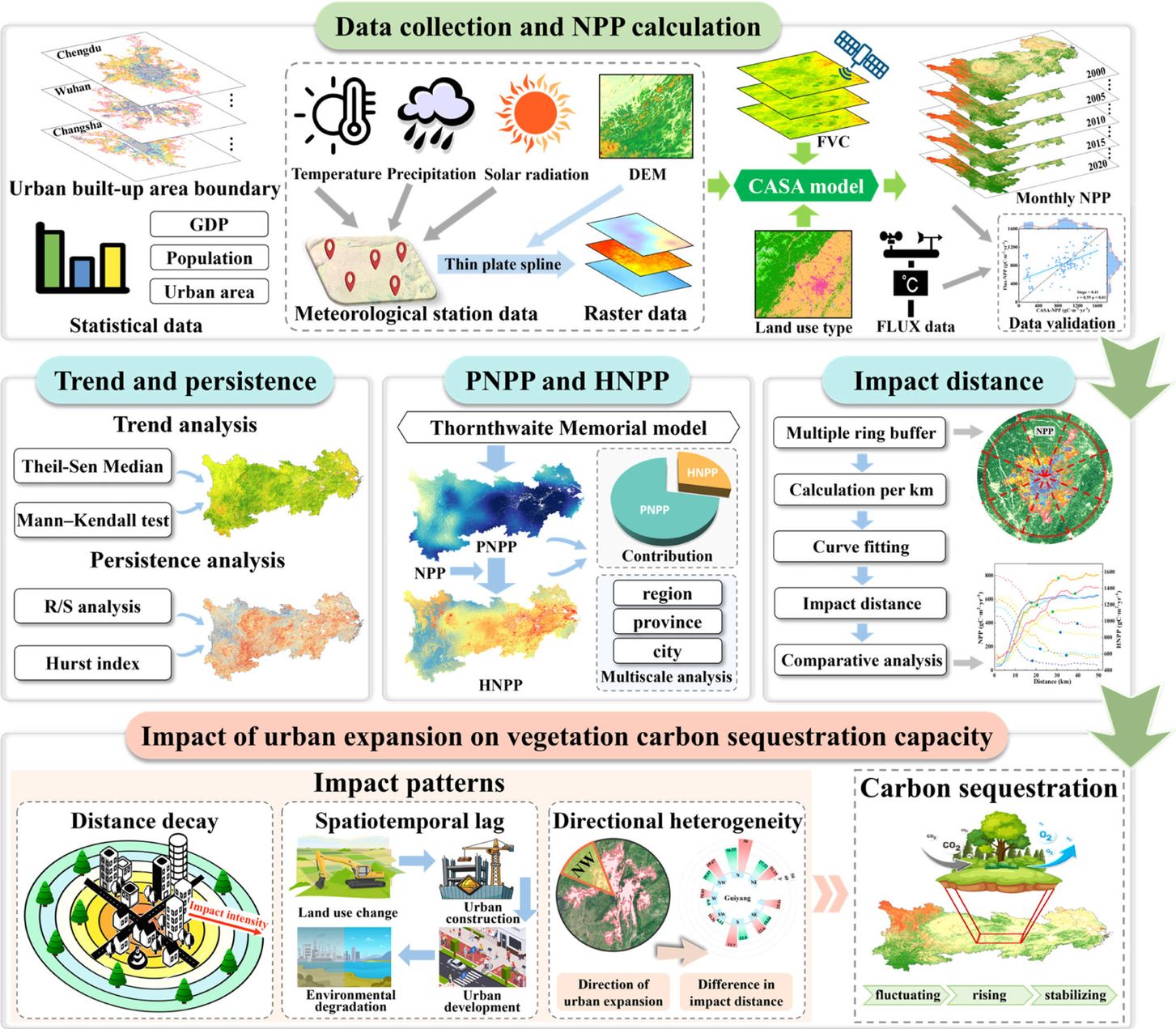
Developing a deeper understanding of how human activities affect urban ecosystems is crucial for designing and promoting sustainable regional development. Although existing studies have explored the causes of environmental changes in cities, there remains a lack in revealing and quantifying the impact of urban expansion on the vegetation carbon sequestration capacity (VCSC). To address these gaps, this study calculated the 20-year monthly Net Primary Productivity (NPP) of vegetation in the Yangtze River Economic Belt (YREB). The contributions of climate and human activities to NPP were quantified across regional, provincial, and urban scales. Furthermore, the variation pattern of urban expansion affects VCSC along urban-rural gradients was investigated. The findings indicated that (1) the annual growth rate of NPP in the YREB was 4.28 gC·m-2·yr-1 from 2000 to 2020, and the cities with the most significant influence of climate and human activities on NPP were Kunming (78.29 %) and Shanghai (40.87 %), respectively. (2) Over the past 20 years, vegetation carbon sequestration in the YREB has experienced fluctuating, rising, and stabilizing stages, with Chengdu and Nanchang growing by 28.02 % and 14.83 %, respectively, during the rising stage. (3) The impact distance of urban expansion on NPP in Shanghai and Hangzhou is greater and occurred earlier, while Kunming and Guiyang exhibited clear directional heterogeneity. This research established a framework to reveal the impact of urban expansion on VCSC, which is beneficial to urban managers in designing evidence-based solutions for sustainable urban development.